
A starter can look alive and still be a poor partner for bread. It bubbles on the counter, smells bracing, doubles overnight, and then the loaf comes out flatter than you hoped. The problem is rarely the starter itself. More often it is timing: the gap between a starter that is merely fermenting and one that is peaked, structured, and ready to lift dough.
What follows is the checklist worth running through before you reach for the flour. No single sign is decisive on its own. Together, they give you a far clearer picture than a clock or a recipe schedule ever will.
The Clock Is a Starting Point, Not an Answer
Feeding ratio, flour, hydration and kitchen temperature all move the schedule. A starter fed 1:1:1 in a warm kitchen can peak in four hours; the same starter fed 1:5:5 on a cool counter might take ten. When a recipe says "wait six hours," it is describing the writer's kitchen, not yours.
So watch the jar instead. Put a rubber band around it at the level of the freshly mixed starter so you have a baseline, then start checking hourly from about hour three in summer, hour four or five in winter. Two or three checks will teach you more about your starter's rhythm than any timetable. A strip of masking tape on the jar and a pencil is enough to keep notes.
The Rise Cues
Rise is the most obvious signal and the most often misread. Look at four things, not one.
A clear, measurable rise. Most wheat starters at 100% hydration will roughly double between feedings, sometimes a little more, sometimes a little less. Rye climbs faster and further; stiff starters can look deceptively modest because the dough is dense. What matters is the rise relative to your own starter's normal, not an absolute number.
A domed top that has not sagged. At peak, the surface is rounded and slightly taut, sometimes with a faint sheen. If it has flattened, wrinkled, or a ring of starter has slid down the glass, you have missed the peak and it is already on the way down.
A sensible window. If a normal feed takes fourteen hours to double at room temperature, the starter is weak or the ratio was too large. If it peaks in two hours and collapses, it is hungry or too warm — feed it more, not more often.
A brief plateau. A good starter holds at the top for half an hour or so rather than rising and collapsing in one motion. That pause is your window to mix dough.
Bubble and Structure Cues
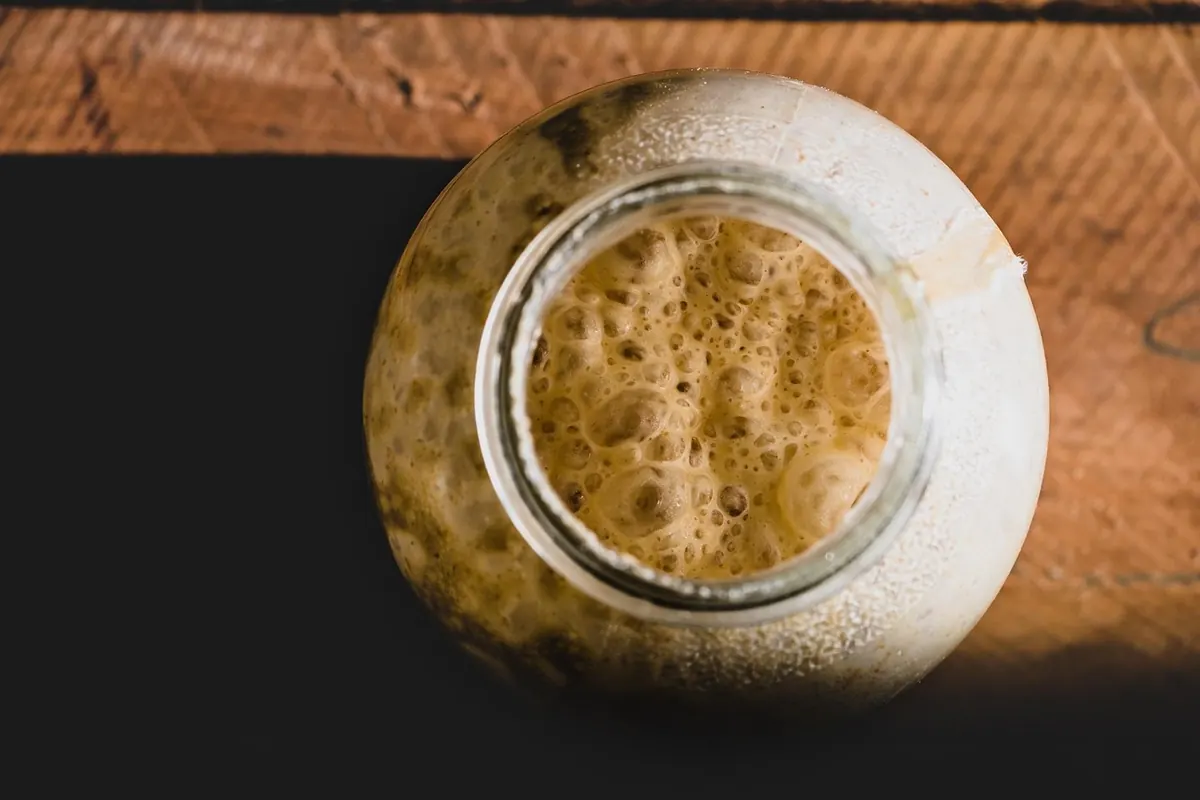
Bubbles through the whole depth. Against the glass you should see a mesh: small even bubbles plus a few larger irregular pockets, all the way down. Bubbles only at the surface mean the activity has not worked through the jar yet.
A webby interior when you stir. Pull a spoon through the middle. It should come up with strands and a slight stretch, like a loose batter with structure. If it pours like milk, it is either not ready or long past it.
Slow, steady surface activity. A gentle release of bubbles at the top, one after another, is what you want. Frantic fizzing usually means the starter is warm and hungry rather than strong.
It floats. A teaspoon of starter dropped into a glass of water should sit on the surface. This test is only really reliable for wet wheat starters at peak; a rye or stiff starter may sink while being perfectly strong. Passing is a good confirmation, failing is not proof of failure.
If you have to talk yourself into it, give it another hour.
The Smell Cues
Smell is the fastest check you can make, and it costs nothing.
A clean, dairy-sour scent. Yogurt, buttermilk, a little vinegar, and underneath it, raw bread dough. It should be a smell you are happy to have on your hands.
No acetone, no drain. Nail polish remover, harsh alcohol, or a sharp stinging note means the starter has eaten through its food and is well past peak. A sewer-like smell usually means it has gone too long unfed. Feed it twice, discarding in between, before you consider baking with it.
Learn the full arc. Right after a feed it smells milky and faint; at peak it turns to yogurt; past peak it drifts toward solvent. If you sniff the jar every time you check, you will soon recognize peak by nose alone — and that is how plenty of experienced bakers actually decide.
Texture and Feel
It resists the spoon a little. A good starter is thick and slightly viscous, and a trail drawn through it closes slowly. Slack, watery starter, or any liquid layer sitting on top, means it is not at peak — separated liquid means it is over.
A dropped spoonful holds its shape briefly. Put a small blob on the counter. A peaked starter sits in a soft mound for a few seconds before slumping. If it spreads immediately, it is too loose or too far gone.
A fingertip taste is optional but useful. At peak it is mildly sour and pleasant. A stinging, metallic or burning taste means it has over-fermented.
The Twelve-Point Checklist
Run this pass before you reach for the flour. You do not need all twelve, but you want most of them, and you want them at the same time — that last part is where most bakers slip.
- Up 50–100% from the rubber band.
- Domed top, no sag and no wrinkles.
- Peaked within a normal window for your kitchen.
- Holding at the top rather than falling.
- Bubbles visible through the whole jar.
- Webby strands when you stir it.
- Slow, steady surface activity.
- A spoonful floats in water.
- Smells of yogurt and raw dough.
- No acetone or drain notes.
- Thick, with a little resistance to the spoon.
- A dropped blob holds shape for a few seconds.
Before You Mix the Dough
Feed the starter at 1:1:1 or 1:2:2, leave it somewhere warm, and mix your dough at the peak rather than the day after. If you cannot bake right then, refrigerate it at or just before peak — it will slow down and hold for a day or two, and you can let it come up slightly before using.
If you are missing several signs, do not bake out of hope. Two or three days of twice-daily feeds at a warm room temperature will revive most sluggish starters, especially in a cold kitchen. Keep a backup too: a spoonful smeared on parchment and dried, or a small jar in the fridge, costs nothing and saves a week. And when in doubt, bake a small test loaf. A handful of dough will tell you more about your starter's strength than any checklist, including this one.
Photo: tombock1 / Pixabay